

The Mathematician’s Story Isolated That probably would have been the first word I used to describe myself only two or three years ago. Isolated, because the people I spent most of my time with were fully immersed in a culture I was just beginning to discover. Isolated, because the people I had grown up with understood me so little, and were so hostile to the person I was becoming, the person I had always been deep down. Isolated, because I had been hurt in ways that few of the people I knew understood. It wasn’t so bad, of course; I had made it most of the way out. I was studying mathematics, which I love with a passion, at UCL, one of London’s top universities. I had mostly come out of my shell, had made fast friendships and built up the emotional support system that empowered me to finally leave my parents’ house, and the ultraorthodox community I’d grown up in. I was tasting real freedom for the first time.What I didn’t realise was that my journey was just beginning. I had to deal with a severe emotional fallout from what I had been through and done. And while my friends were sweet and supportive, few of them could really relate to the kind of place I had just left, the kind of painful experiences that passed for perfectly normal when I was growing up. Try explaining to someone who’s calling you upper middle class because you went to a private school that you actually grew up hungry and had to pay for your own clothes! I had similar experiences when trying to heal psychologically, having to explain my background and upbringing to every therapist I spoke to. I was starting to ache for some normal friends who would, to use the common phrase, get it. I wanted people who would understand without my having to explain. I just didn’t think there were any such people. What I had done was difficult enough, and I had several advantages I knew others would lack.Despite the remaining niggling feeling of isolation that stemmed from my unusual background, I continued to get stronger. I engaged more actively in university social life. I sang in several concerts and took part in an opera, something I could only have dreamed about when I was still living in the community. I increased my volunteering hours. I was going from strength to strength, as they say back home. Everything was going well. That is, until I ran out of money. Freedom, it turns out, is expensive. Especially in London. It shouldn’t have been the big deal it was – I was entitled to quite a bit of student funding. But being estranged from my parents made getting that funding really difficult. After a few weeks of wryly thinking to myself that rent and food were covered in prison, and trying to come up with a suitably petty crime to get there, I decided that there must be some form of support out there for people in my odd situation, and I began searching online. I found GesherEU, and the rest, as they say, is history. Yes, they did tide me over until my funding arrived, and for that I am eternally grateful. They enabled me to maintain that freedom that has been so precious to me ever since I left. But GesherEU, for me, is about so much more than that. It’s support. It’s friendship. It’s a place where people understand where I’ve come from. It’s a place where I don’t have to explain what I’ve been through, because everyone knows. It’s a place where I don’t feel isolated. Not even slightly. Not having to pretend or explain – socially, that’s the biggest freedom of all. And Now I’m about to embark on the next leg of my journey. I’m going to do my PhD in mathematics at Stanford University, which is a huge achievement considering where I come from. I’m really looking forward, but I’m genuinely sad about having to leave all the wonderful folks at GesherEU behind. I will miss you all more than I can say. Footnote. GesherEU helped financially in the move to Stanford. We look forward to welcoming our first PhD back to the UK in a few years’ time. – Editor

Heading On The Derech…
Heading On The Derech…. As a woman who is going along the journey of leaving it all behind to a ‘better life’ or better yet the real ‘Gan Eden’ together with my beautiful children I would like to share with my readers some of my insights I have gotten as we cross the ‘bridge’ and ’go off the derech’ (or on!) with pride! Rules broken so far: 1. Not wearing my ‘shietel’. As I leave the house I get persistent reminders. Child: Hey Mummy! You’re not dressed yet! Me: Yes I am! Child 3: You forgot your shietel Me: I dont need a shietel I have REAL hair and I look just fine! So… as I revell at deserting my fake hair I look at myself in the mirror and see ME for the first time in 12 years! Do I feel ‘not dressed’? No, I don’t! I actually feel like a part of my body which I killed a decade ago has revived itself and I embracing it and giving it the daily TLC it deserves. As for my poor head covering sitting folorn on the shietel head at the bottom of my cupboard, this will be a symbol for my future grandchildren of Bubby’s mesiras nefesh to go and discover her true self. Indeed where has my head been all these years?? – EM (London)

First impressions
First impressions My first encounter with GesherEU was at Limmud 2014. In little more than two short months, my eyes have been opened to a world on my doorstep that remains hidden from the majority of Jews right here in London and indeed across the UK and Europe. This world is the Chasidic communities that many hold to be the practitioners of “authentic” Judaism and perhaps a guarantee for the survival of Judaism in some sort of “even if I don’t do it, they do” kind of way. At her Limmud session however, a young lady described how, having left the Ultra Orthodox community in London, she had set up a support group for those who had left, and now needed help to take the group forward. She described some of the difficulties faced by those who leave and my wife and I put our names on a form, as one does at Limmud and rushed off to the next session. A few weeks and a few emails later, I was setting up a quick website, registering some domain names and setting up some email addresses. It was not until I was invited to attend a support come social meeting, that my eyes became opened to why GesherEU was so important to so many people’s lives. Why would someone fly in from Zurich for a few hours with some acquaintances? Why the secrecy about the location of the evening? Why were so many taking such risks to be there? What was the need that brought these people together? I was worried that, as an outsider, conversation might be difficult. I knew people would have a different background and being a rather introverted (in my opinion) techie, approaching retirement, thought that a quick 20 minutes to show my face was all that would be required. I decided, as midnight approached, that I really should be on my way, upset that I had not had time to talk with many there. The next meeting was again a full house and both my wife and I were able to engage with more GesherEU members. It is heart-breaking to find in such a group of bright intelligent people such upheaval and internal conflict. It became clear that one could not simply list the difficulties people leaving the Ultra-orthodox communities would face and plan solutions at each stage of the process. Each person had a different tale to tell. Children, no children; contact with family, no contact with family, good English, poor English; a secular career, only a religious education. People came who were at different stages of the journey, yet they seemed keen to have their story heard. Some were married, some had been married. A few had left before being married. It became clear that the whole set up of these Ultra-orthodox societies, either by design or by coincidence, made leaving their community a mind-boggling complex operation, if the result was to be a stable and fulfilled life in the wider world. With arranged marriages at eighteen, most already had children before they could understand their emotions, make their plans or get themselves a career. One surprise to me was that the members of GesherEU had not expected the wider Jewish community to be sympathetic. These are people who have been brought up to understand that any other way, be it Jewish or secular, or any mixture of the two is bad. I think ‘bad’ may be somewhat of an understatement on my part. The term commonly used within their (ex-)communities, for people who don’t toe the line is “off the derech” – off the road. Yet, I have found members of the wider Jewish community both sympathetic and supportive and would be much more likely to embrace GesherEU members as part of their own community, than the members of the Charadi community from which they have come. Who is “off the derech” is strictly a point of view. Many members rely heavily on GesherEU for emotional and practical support. It is a privileged to be able to support the brave individuals who are determined to follow their hearts and live a life with the choices for themselves and their children that the rest of us take for granted. – Robert
Jewish marriage in the modern age
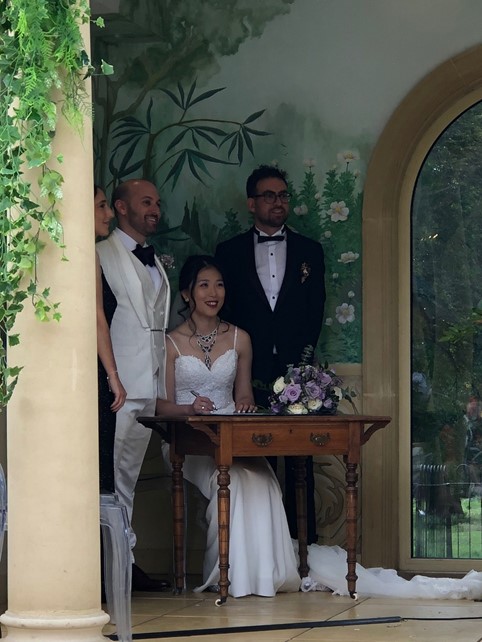
Jewish marriage in the modern age Thinking hard about the nature of the Jewish wedding ceremony can be a disturbing undertaking. As soon as we do so, we discover a dissonance between how we may conceptualise relationships between men and women and how they were understood by the Tanach and the rabbinic tradition. Early sources describe a world of relationships that was thoroughly non-egalitarian. Deuteronomy 24:1 is the primary biblical source that shows the man as the active party both in taking and rejecting a wife: “When a man takes a woman and masters her, and it happens, if she does not find favour in his eyes, for he finds in her something vile, he may write for her a document of cut-off; he is to place it in her hand and send-her-away from his house.” This imbalance is reflected in the earliest rabbinic writings about marriage (Mishnah Masechet Kiddushin Chapter 1), which place the acquisition of a wife in the context of the acquisition of other commodities such as slaves and animals (“She is acquired by money, by document, or by sexual intercourse”). The halachic (Jewish legal) implication of this inequality is that it is only the woman’s status that changes substantially when she marries and not the man’s: she goes from being a “p’nuya” – “an available single woman” – to being “Eshet-Ish” – “woman-of-a-man”. Equally, only she is liable for the harshest punishments under the law should she be sexually unfaithful to her husband. Given that the central act in a traditionalist Jewish wedding is still an act of acquisition (where money, generally in the form of a ring, passes from the man to the woman), anyone choosing to get married mindfully in this way will need to think through their relationship with tradition itself in a profound manner. There are many ways of justifying the continuing use of this Kiddushin ceremony. We can refer to other more egalitarian sources as a means of off-setting the essentially non-egalitarian nature of Kiddushin. We may assert that we are free to re-imagine the meaning of Kiddushin whilst remaining true to its forms. We might choose to tolerate a difference between tradition and ourselves in an act of obedience to the system. We might attempt to defer utterly to tradition and allow it to determine the meaning of our primary relationships. We might simply choose not to study at all and to view the wedding as a personal act that has no reference to the past. Some scholars have suggested that a radical change to the wedding ceremony may be necessary in our day. In Jewish law (halacha), in order for Kiddushin to be valid both parties must consent to the contract undertaken. This means that the woman may need to consent to “being acquired”. Professor Meir Feldblum has written on the current halachic implications of the lack of informed consent of women at the time of marriage. Feldblum writes that “in light of women’s efforts in our day to achieve equality in all spheres of life, there is a presumption, even a categorical presumption, that many women were they to be informed would in no way agree to the acquisition nature of Kiddushin/marriage.” Most women are not informed by their rabbis of what they are agreeing to, and for Feldblum this undermines the full validity of the contract itself. Even worse, if the woman does indeed know the meaning of the ceremony and states explicitly beforehand that she does not believe in or accept the nature of Kiddushin – something that has happened to me on a number of occasions – what does that do to the validity of their wedding ceremony in Jewish law? The most radical approaches to the very real problem of Kiddushin involve going back and re-thinking Jewish weddings from first principles, and avoiding basing them on the laws of acquisition. The American academic Rachel Adler has done just that in her groundbreaking book, “Engendering Judaism”. Her solution involves a ceremony rooted in the Jewish law of partnership, shutafut, rather than the law of acquisition. The central act of such a ceremony replaces the kinyan of Kiddushin, where the man gives an object of value to the woman, with a ceremony where each partner places an object of value into a bag which they then raise together, thereby indicating that they enter into a joint partnership. The terms of their contract are detailed in a “Covenant of Love”, one of the terms of which must be a promise of mutual sexual fidelity for the duration of the partnership. The downside of such an innovation is that it clearly constitutes a radical break with the tradition of a hundred generations of marrying Jews. Many will balk at the very idea of changing such a well-established ritual; many couples will also want their actions and words when they stand under the chuppah to be fully aligned with those of their ancestors so that their ceremony draws directly on those in the past. Others will, however, be driven by the need for a different kind of alignment – one between the wedding ceremony and the lived life of the couple. One significant advantage of this partnership or shutafut ceremony is that it takes place between equals, and the obligations taken on by the participants are intrinsically fully egalitarian. This opens the pathway for shutafut to operate as a method of conducting homosexual marriages in Judaism. Kiddushin-based ceremonies, with their intrinsically hierarchical nature, are less suited to such marriages. The Masorti rabbis in the UK are currently proposing that shutafut rather than Kiddushin is adopted as the legal halachic basis for allowing gay marriages to take place under the auspices of our synagogues in the UK. Whereas Kiddushin between two men or two women is expressly impossible under classical rabbinic law, a partnership agreement between gay couples will be halachically binding and may reflect more closely the nature of their relationships. Many straight couples are already using shutafut

GesherEU’s 2024 Year in Review
GesherEU’s 2024 Year in Review 2024 was an exciting year for GesherEU. This is what we’ve been up to…

