

Following in her Footsteps Chavie Weisberger is the Director of Community Engagement at Footsteps, GesherEU’s American sister organisation. We spoke to her about her life, her role and what our organisations can learn from each other. When Chavie Weisberger came over to the UK to visit GesherEU in the summer of 2023, she hoped to find fresh energy and inspiration for her work in the US. Like GesherEU, Footsteps supports people who were raised in the ultra-orthodox communities, and are looking to leave it for a life of their choosing. It currently has 2,500 members across the US, and some who live around the world, and helps people with education, career guidance, community connection and finances. She says she was pleasantly surprised to see how similar the two organisations are: “I felt like you could transplant everybody from one place and put them together in a room, and the conversations would be the same,” she says. “The trip helped me to regain my perspective of how important community is and how universal the experience of leaving fundamentalist religion is – how the experiences of our friends in London are the same as the experiences of folks here in New York. “People are struggling with custody of their kids. People are struggling with relationships with family. The world needs to know that these injustices are happening to people all over. It gave me fresh fire under my loins, a desire to make global change and to bring global awareness of the issues we’re facing.” “I needed to figure out who I was, what I believed, and how I wanted to raise my children.” Chavie, now 41, was raised in a Chasidic community in Monsey, Rockland County, in the state of New York. The fifth of 10 children, her mother’s family came from the Emunas Yisroel sect, and her father, the Klausenburg sect. Engaged at 18 and married at 19, she had her first child at 20. By the time she’d had her third, at 24, she’d realised her husband wasn’t a ‘good fit’. “I built up the courage to ask him for a divorce,” she says. “I was 25 when I left him and became a single parent to three children. I was still in the community, still religious, but I needed to figure out who I was, what I believed and how I wanted to raise my children.” As she struggled to raise her children alone, Chavie also began to wrestle with her sexuality: “I was trying to reconcile my queer identity with my religious identity. Over the years, I met different people and had different experiences, and I realised that there was no room for me in the Chasidic community as my true, full self.” At 30, she came out both as queer and an atheist. One day, for the first time, she walked out of her apartment wearing jeans, without her wig. “That got the biggest shock reaction. And once people started to learn more about the intimate details of my beliefs and my values and my lifestyle, they started to get upset about all of it. Internally, it was a long process. But externally, for everyone in the community, it was a bombshell.” No sooner had Chavie come out publicly than her ex-husband took her to court to fight for custody of the children, then aged five, seven and nine. She reached out for legal support to a non-profit organisation called Unchained at Last, which was run by someone who was also OTD (had left the community). For the next 10 years, she was in and out of court, fighting for custody of her children and struggling financially. “It was an awful, awful process,” she recalls. “My family shut me out of their lives, I lost my friends and I lost the ability to give my children what every child needs – a larger network of support. The whole community ganged up against me and I felt there was no way I was going to make it out of this with my children intact. Finding Footsteps and Eshel, an LGBTQ Orthodox Jewish Organisation, helped me to build a new social support structure.” In 2016, the worst happened: she lost custody of her children. She immediately appealed the decision and, in 2017, won her appeal: “I won the right to raise my children as my full self. It was ruled unconstitutional that I would have to hide any parts of myself from my children. And so, I was able to share my values and raise them as the person that I am. “Fast forward to today, and my children are now 20, 18 and 16, and they’re all thriving. My two older ones graduated from a secular high school, and one of them is in college and the other one is in art school. And my youngest is a junior in high school. I’m doing really well and it feels like I’ve made it to the other side.” “When you leave the community, so much is taken from you.” Her career at Footsteps began in 2015, in the midst of her court battle. Previously a school teacher, she had also been the editor of a Chasidic women’s magazine – which fired her when she came out – and then worked in real estate. “Footsteps offered me my first job outside the Charedi community, as an entry level associate for the community engagement team. A year earlier, they’d honoured me for my achievements – I had already been hosting Shabbat dinners, Mother’s Day picnics, holiday events, so that my children could feel connected to others. The job felt like a continuation of what I was doing, allowing me to follow my passion. But it enabled me to do it with more resources, and to create new programmes.” Chavie says Footsteps gives people the ability to access and make choices: “When you leave the community, so much is taken from you, and we want to ensure that people have the resources
Day of Choice 2023
Day of Choice 2023 The international Day of Choice is an annual event, which takes place every 27th October, to raise awareness of the issues facing people who leave ultra-Orthodox communities across the world. https://youtu.be/CgF2Q7I13TI GesherEU is part of a global movement for change. Together with our sister organisations in the US, Europe, Israel and Australia, we want to ensure that everyone who leaves gets the social, emotional, educational and practical support they need to live a life of their choosing, despite the many obstacles they face. We also campaign for societal and legislative change. The terrible events in Israel mean that, this year, our celebrations are muted, but we feel it is still important to mark the day. For the Day of Choice 2023, we have made a short film explaining what we do and celebrating the achievements of our members. We will be showing this film at a future event for members, and at screenings for the wider community and funders. Thank you to Motti, Moishy, Chaim and Sarah for taking part in our documentary. Thank you to Turquoise TV for producing the film. Day of Choice website: https://day-of-choice.org.il/en/
Q&A with Vicky Jones
Q&A with Vicky Jones Vicky Jones has been GesherEU’s Welfare Officer since October 2022. We asked her to tell us more about herself and what she does. Tell us about yourself and what you did before you came to GesherEU I live in East London, with my partner, my stepson and my cat. I grew up in Bournemouth, a little seaside town, and first went to agricultural college. In my early 20s, I moved to London and started working with people with learning difficulties. From there, I went on to be a disability employment adviser and then I worked with homeless people. One of my tasks involved doing street outreach, which meant walking around Central London in the middle of the night, talking to homeless people and trying to get them indoors. I could tell you some stories about that – like the night I was pepper-sprayed by the police, by mistake, or the times I was flashed at. I’ve also worked in women-only services. For five years, I was a service manager of a project in Kings Cross for women involved in street-based prostitution and sex trafficking. And in my last job before I joined GesherEU, I was a senior worker in a homeless drop-in in Wimbledon. I’ve faced some mental health challenges of my own in the past, which is why I now work part-time. What attracted you to the job of Welfare Officer at GesherEU? All my work has been around helping people to make changes in their lives, encouraging them to find their skills and talents, and motivating them. I’m essentially a very nosy person and I like the fact that in my job I can ask people intimate questions and really find out what makes them tick. I’ve worked with people from virtually every country in the world at some point in my career – different religions, cultures, languages. But I’ve never before worked with the Charedi community, or even anybody who described themselves as Jewish. Perhaps it’s because Jewish communities tend to have their own organisations which scoop people up when they’re in need. What exactly does your role entail? GesherEU refers people to me, and I I help with practical things, such as court processes, benefits, housing, budgeting, how to sell your car – anything they may need to do in day-to-day life. A lot of my job involves filling out benefit forms, hooking people up with legal advice, accompanying them to appointments, going to court. Some members can’t see their children, so I help them to try to rebuild contact. I also do a lot of emotional and mental health support from helping with low mood, anxiety and depression to getting emergency mental health care. Safeguarding is a big part of my job – if, for example, someone is worried about their children’s care back in the community, I will make a safeguarding report to social services. Boundaries are a big issue for GesherEU members, because they’ve grown up in a world where all the boundaries and processes are put in place for them, and they’re very strict. But outside the community, people make their own boundaries in life – what they will tolerate and what they won’t. It can be hard for members to make decisions, to have confidence in themselves, because they’ve never had to before. They often don’t have a proper education, or even speak English fluently, and they can be very naive about life in the outside world. I always say to members, if you’ve got any question, ask me. If I don’t know the answer, I’ll find out who does and I will help you access the right support. There’s no limit on how long I can work with people. For many, it’s a long-term relationship. The goal is that people become independent and don’t need me, but there’s no time limit on that. I work three days a week, but I make sure everyone knows they can always message me if they have an issue. You’re not Jewish. Has it been a problem and has getting acquainted with Judaism been a steep learning curve for you? Not being Jewish has its advantages and disadvantages. The main advantage is that people can be sure I have no connection with the community, with the Jewish world, so nothing they say to me is ever going to get back to anyone. But the disadvantage is that they worry I don’t understand where they’re coming from or why they think the way they do. Sometimes, people try to work out what my motivation is. The truth is, I just like people and want to make their lives better. I don’t know many Jewish people outside of GesherEU. I have met a few – there was a girl in my class at primary school, for example – and I knew the basics, about menorahs and Friday night dinners, and Passover, the cultural stuff, but I knew nothing about the religious side. I certainly hadn’t come across any Charedi people, because they keep themselves so closed off. Since I started my role, I’ve been doing lots of reading, watching lots of documentaries about Judaism. I also have a mild obsession with North Korea, and I’m fascinated by controlled societies and how people survive. I’m learning all the time. If, for example, there’s a religious holiday, I will read up on it so I understand its significance. I’ll also ask members to explain things to me, as the best people to explain something are those who have actually experienced it. Ultimately, people are people, no matter their background or where they come from. We all need to feel love, to be valued, to have agency over our lives and hope for the future. What have you found most interesting about your job? What’s been fascinating to me is how so many of the people I meet through GesherEU talk about feeling like a refugee. I’ve worked with refugees and asylum seekers in the past, and there are so

First impressions
First impressions My first encounter with GesherEU was at Limmud 2014. In little more than two short months, my eyes have been opened to a world on my doorstep that remains hidden from the majority of Jews right here in London and indeed across the UK and Europe. This world is the Chasidic communities that many hold to be the practitioners of “authentic” Judaism and perhaps a guarantee for the survival of Judaism in some sort of “even if I don’t do it, they do” kind of way. At her Limmud session however, a young lady described how, having left the Ultra Orthodox community in London, she had set up a support group for those who had left, and now needed help to take the group forward. She described some of the difficulties faced by those who leave and my wife and I put our names on a form, as one does at Limmud and rushed off to the next session. A few weeks and a few emails later, I was setting up a quick website, registering some domain names and setting up some email addresses. It was not until I was invited to attend a support come social meeting, that my eyes became opened to why GesherEU was so important to so many people’s lives. Why would someone fly in from Zurich for a few hours with some acquaintances? Why the secrecy about the location of the evening? Why were so many taking such risks to be there? What was the need that brought these people together? I was worried that, as an outsider, conversation might be difficult. I knew people would have a different background and being a rather introverted (in my opinion) techie, approaching retirement, thought that a quick 20 minutes to show my face was all that would be required. I decided, as midnight approached, that I really should be on my way, upset that I had not had time to talk with many there. The next meeting was again a full house and both my wife and I were able to engage with more GesherEU members. It is heart-breaking to find in such a group of bright intelligent people such upheaval and internal conflict. It became clear that one could not simply list the difficulties people leaving the Ultra-orthodox communities would face and plan solutions at each stage of the process. Each person had a different tale to tell. Children, no children; contact with family, no contact with family, good English, poor English; a secular career, only a religious education. People came who were at different stages of the journey, yet they seemed keen to have their story heard. Some were married, some had been married. A few had left before being married. It became clear that the whole set up of these Ultra-orthodox societies, either by design or by coincidence, made leaving their community a mind-boggling complex operation, if the result was to be a stable and fulfilled life in the wider world. With arranged marriages at eighteen, most already had children before they could understand their emotions, make their plans or get themselves a career. One surprise to me was that the members of GesherEU had not expected the wider Jewish community to be sympathetic. These are people who have been brought up to understand that any other way, be it Jewish or secular, or any mixture of the two is bad. I think ‘bad’ may be somewhat of an understatement on my part. The term commonly used within their (ex-)communities, for people who don’t toe the line is “off the derech” – off the road. Yet, I have found members of the wider Jewish community both sympathetic and supportive and would be much more likely to embrace GesherEU members as part of their own community, than the members of the Charadi community from which they have come. Who is “off the derech” is strictly a point of view. Many members rely heavily on GesherEU for emotional and practical support. It is a privileged to be able to support the brave individuals who are determined to follow their hearts and live a life with the choices for themselves and their children that the rest of us take for granted. – Robert
Jewish marriage in the modern age
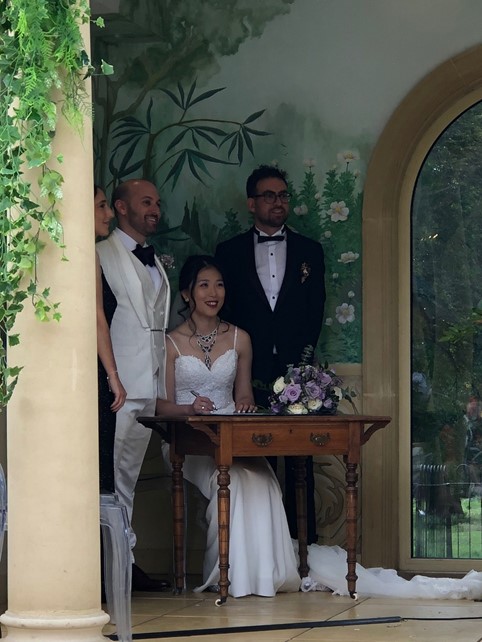
Jewish marriage in the modern age Thinking hard about the nature of the Jewish wedding ceremony can be a disturbing undertaking. As soon as we do so, we discover a dissonance between how we may conceptualise relationships between men and women and how they were understood by the Tanach and the rabbinic tradition. Early sources describe a world of relationships that was thoroughly non-egalitarian. Deuteronomy 24:1 is the primary biblical source that shows the man as the active party both in taking and rejecting a wife: “When a man takes a woman and masters her, and it happens, if she does not find favour in his eyes, for he finds in her something vile, he may write for her a document of cut-off; he is to place it in her hand and send-her-away from his house.” This imbalance is reflected in the earliest rabbinic writings about marriage (Mishnah Masechet Kiddushin Chapter 1), which place the acquisition of a wife in the context of the acquisition of other commodities such as slaves and animals (“She is acquired by money, by document, or by sexual intercourse”). The halachic (Jewish legal) implication of this inequality is that it is only the woman’s status that changes substantially when she marries and not the man’s: she goes from being a “p’nuya” – “an available single woman” – to being “Eshet-Ish” – “woman-of-a-man”. Equally, only she is liable for the harshest punishments under the law should she be sexually unfaithful to her husband. Given that the central act in a traditionalist Jewish wedding is still an act of acquisition (where money, generally in the form of a ring, passes from the man to the woman), anyone choosing to get married mindfully in this way will need to think through their relationship with tradition itself in a profound manner. There are many ways of justifying the continuing use of this Kiddushin ceremony. We can refer to other more egalitarian sources as a means of off-setting the essentially non-egalitarian nature of Kiddushin. We may assert that we are free to re-imagine the meaning of Kiddushin whilst remaining true to its forms. We might choose to tolerate a difference between tradition and ourselves in an act of obedience to the system. We might attempt to defer utterly to tradition and allow it to determine the meaning of our primary relationships. We might simply choose not to study at all and to view the wedding as a personal act that has no reference to the past. Some scholars have suggested that a radical change to the wedding ceremony may be necessary in our day. In Jewish law (halacha), in order for Kiddushin to be valid both parties must consent to the contract undertaken. This means that the woman may need to consent to “being acquired”. Professor Meir Feldblum has written on the current halachic implications of the lack of informed consent of women at the time of marriage. Feldblum writes that “in light of women’s efforts in our day to achieve equality in all spheres of life, there is a presumption, even a categorical presumption, that many women were they to be informed would in no way agree to the acquisition nature of Kiddushin/marriage.” Most women are not informed by their rabbis of what they are agreeing to, and for Feldblum this undermines the full validity of the contract itself. Even worse, if the woman does indeed know the meaning of the ceremony and states explicitly beforehand that she does not believe in or accept the nature of Kiddushin – something that has happened to me on a number of occasions – what does that do to the validity of their wedding ceremony in Jewish law? The most radical approaches to the very real problem of Kiddushin involve going back and re-thinking Jewish weddings from first principles, and avoiding basing them on the laws of acquisition. The American academic Rachel Adler has done just that in her groundbreaking book, “Engendering Judaism”. Her solution involves a ceremony rooted in the Jewish law of partnership, shutafut, rather than the law of acquisition. The central act of such a ceremony replaces the kinyan of Kiddushin, where the man gives an object of value to the woman, with a ceremony where each partner places an object of value into a bag which they then raise together, thereby indicating that they enter into a joint partnership. The terms of their contract are detailed in a “Covenant of Love”, one of the terms of which must be a promise of mutual sexual fidelity for the duration of the partnership. The downside of such an innovation is that it clearly constitutes a radical break with the tradition of a hundred generations of marrying Jews. Many will balk at the very idea of changing such a well-established ritual; many couples will also want their actions and words when they stand under the chuppah to be fully aligned with those of their ancestors so that their ceremony draws directly on those in the past. Others will, however, be driven by the need for a different kind of alignment – one between the wedding ceremony and the lived life of the couple. One significant advantage of this partnership or shutafut ceremony is that it takes place between equals, and the obligations taken on by the participants are intrinsically fully egalitarian. This opens the pathway for shutafut to operate as a method of conducting homosexual marriages in Judaism. Kiddushin-based ceremonies, with their intrinsically hierarchical nature, are less suited to such marriages. The Masorti rabbis in the UK are currently proposing that shutafut rather than Kiddushin is adopted as the legal halachic basis for allowing gay marriages to take place under the auspices of our synagogues in the UK. Whereas Kiddushin between two men or two women is expressly impossible under classical rabbinic law, a partnership agreement between gay couples will be halachically binding and may reflect more closely the nature of their relationships. Many straight couples are already using shutafut

