
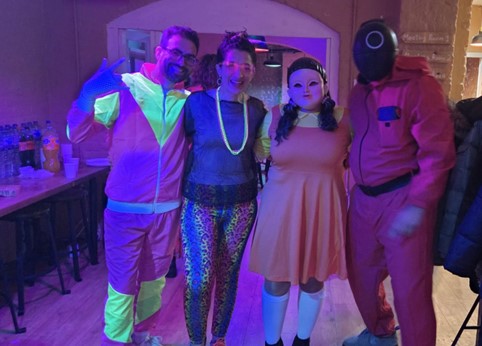
Partying Like It’s 400 BCE If you’d been wandering around East London on March 14th, you might have thought you’d fallen down a rabbit hole. Characters from Alice in Wonderland mingled with men in tutus, and menacing masked guards from Squid Game chatted to couples clad in neon 80s-style Lycra. In fact, you’d have found yourself at GesherEU’s annual Purim extravaganza – the biggest and best yet – where around 25 members got together to enjoy a fancy-dress party with music, dancing, drinks and a finger-food buffet. Historically, GesherEU’s Purim party always took place at founder Emily’s house. But the membership has now outgrown her living room and, this year, the charity wanted a larger, more atmospheric celebration. The chosen venue was a New York-style loft space in Shoreditch. Organiser Moishy Wajnsztok put together a playlist of dance tracks, with a few Purim tunes sprinkled in to mark the Jewish celebration. He and his girlfriend, who is Kurdish, even attempted a traditional Kurdish dance. Yehuda, a member who attended, said: “The party was lovely and a great chance to catch up with friends, make new ones, dance and experience Purim in my own way.” Another commented, anonymously: “The party was amazing. It felt really nice that you could let loose and enjoy celebrating Purim with people who are in the same boat as you.”
GesherEU’s Residential Weekend Away 2025
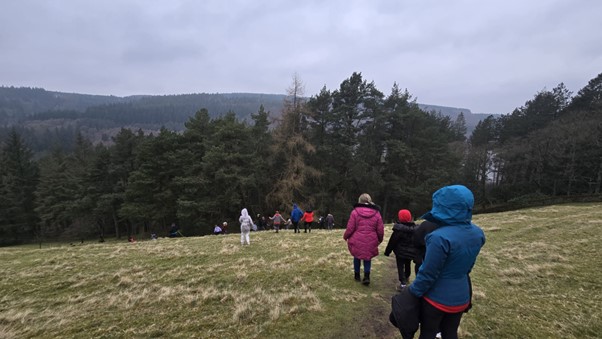
GesherEU’s Residential Weekend Away 2025 GesherEU’s annual residential weekend is now the highlight of our calendar – a chance for members and their families to get together, have fun, share their experiences, and build community. This year’s weekend away was the most successful – and largest – ever. It took place between 14th and 17th February in its usual venue, a converted old pub in the Peak District. But the event has now become so popular – with 50 adults and children attending – that we had to hire two extra houses to fit everybody in. “We have more and more people wanting to come every year, as the event’s popularity spreads by word of mouth,” says GesherEU event organiser, Moishy Wajnsztok. “It’s such a good way for people to come together and make new friends, and it’s also an opportunity for people who might not otherwise be able to afford a holiday to get away.” Shakshuka and Tutus Even the rainy and cold weather couldn’t dampen people’s spirits. Some members donned tutus and Hawaiian garlands for a fancy dress dance party. Other highlights included a talent show, countryside hikes, karaoke and table football. Member and trustee Motti Kalikstein was once again tasked with cooking for everyone, serving up an array of dishes from shakshuka to roast chicken. “The food was delicious,” says Moishy, “but a few fussy kids weren’t impressed. They would only eat plain pasta, so we had to send someone out for supplies. I’ve made a note to make sure we have plenty of pasta in stock for next year.” Anonymous feedback from the weekend was overwhelmingly positive. One member said, “You have created both an amazing and strong community and the most amazingly organised, fun packed, welcoming weekend.” A second wrote: “To all of you, thank you for your wonderful company. It was uplifting and filled with positive energy contributed to by all.” And another commented: “Thank you so much for making me and the children feel so welcomed. We had a really lovely time! Thank you as well to everyone who organised and for the amazing food. You guys are incredible.” Moishy is already planning next year’s event and looking for a new – and larger – venue.

Yom Kippur: A Time for Reflection and Renewal
Yom Kippur: A Time for Reflection and Renewal Yom Kippur is on Saturday. I kind of forgot about it. It was not something my brain was spending energy on. I was reminded by my brother who called, asking to borrow a book. He’s not usually a reader and didn’t explain why. It took me some time to figure out that he might be very bored all day. Yom Kippur is also the first time I “broke” anything big. I slept in and went to shul to meet a friend. He lived alone, and suggested going back to his. I had brought my phone with me. We convinced ourselves that we were “allowed” to use our phones (and possibly smoke too). All it took was a short conversation between us involving some mental gymnastics, and our consciences were clear. I went back to yeshiva that winter and began to think less about breaking Shabbos. That was 12 years ago, and it’s been a long journey. Thinking “hey, you shouldn’t break Shabbos” came in ebbs and flows over the years. I fluctuated back and forth on the religious spectrum, never quite sure where to settle. I haven’t felt bad about treating Saturdays – and Yom Kippur in this case – like an extra weekday for quite a while now. Now, it’s a day for me to choose how to make the most of. Whether I use it for downtime, running errands, or spending time with loved ones, I see it as another day to make the most of. I’m going to the Taskmaster Live Experience on Saturday. I love the show, so I overpaid for tickets on launch day and have been looking forward to it since. I booked the tickets as fast as possible, picking a random Saturday that looked empty in my calendar without giving it a second thought. Turns out that Yom Kippur falls on this random Saturday too, so I must remember to stop by my parents on Friday to wish them an easy fast and that they may be sealed in the Book of Life. Written and submitted by GesherEU member, Sheya.

Pini on the Roof
Pini on the Roof GesherEU’s very own Pini Brown is the star of a brand new documentary short film, which will be shown at the UK Jewish Film Festival this November. ‘Pini on the Roof’ follows Yiddish Blues singer Pini, who left the Hasidic community in Stamford Hill five years ago and is now a mini-celebrity in the hipster neighbourhood next door. In this humorous and moving day-in-the-life portrait, he navigates belonging in the secular world while not rejecting where he came from. The film was a winner of the Dangoor UK Jewish Film Short Docs Fund this year, a project which aims to document modern-day British Jewish life in a series of creative and original four-minute documentaries. This premiered at the Finchley Phoenix in November 2024, with screenings in Manchester, Birmingham, Bath, Brighton, Glasgow, Leeds, Liverpool, and Oxford.

Gesher EU’s Summer 2024 Reading List
Gesher EU’s Summer 2024 Reading List We asked GesherEU members to recommend books that had resonated with them, whether novels or non-fiction. Here are the top ten: All Who Go Do Not Return by Shulem Dean The personal story of a religious, divorced Jewish husband and father who chooses to live a secular life in New York City. A GesherEU member says: “I found it to be a good reflection of people leaving the community.” Big Bang by Simon Singh A fascinating exploration of the most important scientific discovery of all time – the Big Bang theory. AGesherEU member says: “The story of how humans explained the universe throughout history, and how our understanding evolved over the centuries.” Unorthodox: The Scandalous Rejection of My Hasidic Roots by Deborah Feldman A memoir of leaving the ultra-orthodox community in New York, now also a major Netflix drama series. Becoming Eve by Abby Chava Stein The powerful coming-of-age story of an ultra-Orthodox child who was born to become a rabbinic leader and instead became a woman. Kissing girls on Shabbat by Sara Glass A memoir about one young woman’s desperate attempt to protect her children and family while also embracing her queer identity in a controlling Hasidic community. The Chosen by Chaim Potok The classic story of a friendship between two Jewish boys from different backgrounds. A GesherEU member says: “Potok is an incredible writer.” Disobedience by Naomi Alderman A novel about a woman who returns to the ultra-orthodox community In London where she grows up and confronts her past. A GesherEU member says: “A great read but I could tell the author didn’t grow up in the Charedi community.” Sapiens: A Brief History of Humankind by Yuval Noah Harari One of the world’s preeminent historians and thinkers, Yuval Noah Harari challenges everything we know about being human. A GesherEU member says: “This puts humankind and religion into perspective.” Foreskin’s Lament by Shalom Auslander A brutally funny coming-of-age memoir about a man growing up in – and then breaking free from – the ultra-orthodox community. A GesherEU member says: “So funny and brilliantly written. The way he showed the crazy logic behind some of the rules we grew up with! Totally made me an atheist!”

“I like having some level of ambiguity”
‘I like having some level of ambiguity’ Darren Kraushar, 30 is an intersex trans man, who works as a mathematics lecturer at the University of Utah. He shares his experience of growing up in the Charedi community in Hendon, North London, and how his life has changed since he left. “As a child, I always figured that they’d misidentified my sex at birth. I was born with a genetic mutation that’s generally referred to as NR51A, which causes a range of different disorders in sex development (DSD). I think I was initially misdiagnosed with partial androgen sensitivity, and assigned female, when actually I had partial gonadal dysgenesis (abnormally developed testicles). That meant my birth certificate said ‘female’ and I was brought up as a girl – when I felt I was a boy. My name was Naomi. In the Charedi community, boys and girls are brought up completely separately – they’re more or less a different species. As a child, I didn’t have boy playmates, but I wished I had, and whenever I got a chance to hang out with boys, I did. Sometimes I got in trouble for crossing the invisible line. I didn’t know exactly what it meant to be a boy, but I knew that ‘boys don’t cry’, so I tried not to cry. In some ways, you get a better deal in life in the community if you’re raised female – I had a better education and I wasn’t made to focus all my energy on studying the Talmud. I was able to take a bunch of GCSEs and then A levels, which I wouldn’t have been able to do as a boy. But on the other hand, I felt offended by that because I was aware I was only allowed to do those things because everyone thought I was a girl. The community doesn’t believe it’s worth imposing so many restrictions on girls because they’re not obligated to study Torah. My feelings about it all were complicated, and nobody was ever willing to help me process them. The only thing that mattered to my loved ones was the fact they knew I couldn’t have children. They worried about whether I’d be able to get married or participate in traditional, heteronormative intercourse. To be honest, I’d have been difficult to marry off anyway, because I was headstrong and intelligent and didn’t automatically respect men just because they studied a bunch of Talmud. I always got on better with people who were significantly less religious than my parents, people who had slightly more worldly knowledge. ‘Very few people in the community would be willing to go into a marriage with someone who is infertile, unless they’d already had children’ At about 18 or 19 I did have an awkward exchange with a very nice and understanding matchmaker. But it wasn’t until a few months ago, when I was 30, and had long left the community, that I finally heard back from him with an actual match! It amuses me to think it took over 10 years for him to find me someone. Very few people in the community would be willing to go into a marriage with someone who is infertile, unless they’d already had children. At 14, I started going through male puberty. That’s when other people became aware that something was up with Naomi – especially my parents. I wasn’t able to talk to them, or anyone, about this. Despite presenting as female, I had normal male hormones. It meant my voice broke and I started developing facial hair, while everybody else around me at my girls’ school was talking about getting their period and wearing their first bras. I felt like an alien. Small children would stare and point out my moustache, and classmates asked me if I was growing a beard. I think adults assumed I had a hormone problem like PCOS. I sometimes wondered this myself. My feelings were ambivalent. On the one hand, I didn’t have an issue with my body on a personal level, but on the other, on a societal level, it was causing me a lot of difficulty in life. I busied myself shaving my legs and shaving my face, trying to fit in better. My medical nightmare Although I didn’t want to go, my mother dragged me to the GP because I wasn’t growing breasts or starting my periods. The GP’s attitude was, ‘Some people go through puberty slower.’ I’m not sure how they he explained away the broken voice. Eventually, my mother bullied the GP into getting me a referral to the Royal Free Hospital. That was bad – the beginning of my medical nightmare. Thanks to the fierce, almost obsessive modesty in that community, being repeatedly stripped and examined by strangers was really unfamiliar and traumatic to me. Worse, I had this constant feeling of ‘they’re trying to figure out what kind of freak I am’. My parents made it worse by imposing their Charedi cultural sensitivities onto the doctors. They weren’t allowed to be blunt and frank and talk about what normal male or female reproductive systems looked like to me. My parents thought I wouldn’t know what a penis looked like, or what a prostate was. So, all I really got out of it was the fear that, once they’d discovered what kind of freak I was, then they were going to cut me up so that I was less of a freak. That’s pretty much exactly what happened. After being shunted from clinic to clinic, I ended up at UCLH, where everyone with a DSD ends up. I felt helpless and threw a tantrum when they tried to do a blood test. The doctors thought I had a needle phobia and got a psychologist to talk to me, but the needle wasn’t the problem – it was what I feared they’d do to me when they got the test results. So I took a needle from the supply and pricked my

My First Date Was Like A Job Interview
My First Date Was Like A Job Interview In the Charedi community, people marry at a very young age, and all marriages are arranged. This makes navigating the dating scene a particularly daunting task for those who choose to leave. We spoke to three GesherEU members about their experiences of dating and finding love in the secular world. Motti was not yet 17 – an age when most teenage boys are more concerned with playing football – when his parents started preparing him for marriage. “To get married earlier was considered a form of success,” he recalls, now aged 37. “The earlier you are married, the more popular you must be. So at the time, it was flattering and I didn’t see why I shouldn’t get married as quickly as I could.” His parents set about finding a suitable bride. Less than a week after he first heard his potential fiancee’s name, he had travelled from Israel, where he was in Yeshiva, to London to meet her. He says it was a mere formality. “On Monday morning we were on the plane to London and by Monday afternoon I was engaged.” It was a few weeks before his 18th birthday. “The assumption was always that the trip would end up in an engagement,” he explains. “It’s very rare for a boy or girl to meet more than one person or to meet more than once – it almost never happens. Nobody ever asked me what I wanted in a woman, and it’s got nothing to do with physical attraction. It’s about family status.” Naomi* (name changed), 42, who was married at 20 – already on the ‘old’ side for a Charedi bride – agrees. “What happens in the community has no relationship to dating,” she says. “It’s vetting. There’s a list of names and the couple is put together based on the family’s reputation, how much money they have, things like that. And if both families are agreeable, the match will go ahead. It’s about whether someone is suitable – devout enough, with a good reputation and status – not about whether they’ll make you happy.” At the time of his engagement, Motti didn’t speak any English, just Hebrew and a smattering of Yiddish, so he could barely converse with the girl his parents had chosen for him. When he arrived at the meeting, a celebration with drinks and food had already been prepared – which put him under still more pressure to agree to the match: “You just need to give the word, and everybody is waiting on the phone to hear the news of your engagement.” He admits he did feel a flutter of excitement at the thought he’d be meeting the person he would be spending his life with. It was short-lived.“The conversation was, I would say, awkward. I had never spoken to a woman or girl since my early childhood. I didn’t even speak to my female cousins. I had no idea what to do, apart from the instructions I’d been given by a mentor at yeshiva. He’d told me I needed to tell the girl that I wanted to start a Jewish home, and have a Jewish family, following the rules of the Torah. Then I needed to ask her if she agreed and, if she said yes, I would say yes too. It was a verbal contract, agreeing to a certain lifestyle. What he didn’t say was that, if later, someone didn’t fancy this lifestyle anymore, they would be in breach of contract.” “Breaking an engagement is seen as a bigger stigma even than divorce.” Just 45 minutes after meeting, Motti and his intended bride had agreed to their match. But hours later, he began to feel he’d made a big mistake. It was too late to back out. “I felt like I’d signed myself into something I didn’t understand. I felt completely paralysed, a heaviness I couldn’t explain. I knew that breaking an engagement is seen as a bigger stigma even than divorce.” Several years later, he learned that after the meeting, his intended had expressed doubts about the marriage to her parents, feeling a lack of connection, but had been persuaded to go ahead regardless. He didn’t see or have any more contact with his fiancee for a whole year, until the day of the wedding. “You’re supposed to go back to Yeshiva and forget about it,” he explains. “A boy is not supposed to think about women or girls, even the girl they’re going to marry.” “My father actually listened in on us, through a hatch.” When Naomi met her future husband, it was the first time she’d ever spoken to a boy. “I had no experience. I just knew that my father was very keen on this guy. Trying to make conversation was very awkward and uncomfortable. My father actually listened in on us, through a hatch in my grandmother’s house. “Afterwards, I felt, I don’t really know this person, and I didn’t feel sure. But my father dismissed my feelings. He said, ‘Everybody does it. It’ll be fine. You’ll be fine. It’ll be difficult in the beginning but you’ll get used to it.’” But it wasn’t fine, and she didn’t get used to it, in large part because she wasn’t attracted to her husband. Naomi says her wedding night was a traumatic ordeal because she felt obliged to have sex with a total stranger. She had borrowed a biology book before her wedding, to learn about how children were made, but felt unable to talk to anyone about the intimate side of her relationship. Despite going on to have four children together, the physical side of her marriage continued to be an issue: “I was angry that my parents and the community just expected me to live with my husband and never enjoy sex, ever, for the rest of my life,” she says. “Love is not a Charedi thing,” states Pini, 26. “When people get engaged, the talk

An Unorthodox Approach to Parenting
An Unorthodox Approach to Parenting GesherEU has a new parenting group. We spoke to three members to find out how it helps them. When Jamie* was granted access to see his children for the first time in three years, he was excited to re-establish contact, but had no idea how he would interact with them, after so long apart. “My five-year-old boy isn’t growing up with me,” he explains. “He’s still in the Charedi community, which I have left. I felt clueless about what boys his age in the community like to play, or what gifts to take my children, and I didn’t want to get it wrong.” To find answers to his questions, he joined GesherEU’s new online parenting group, where he could ask other people who had shared similar experiences, and get peer support. “People recommended things to me,” he says. “I ended up buying some Lego, which I could build with my son, and this week I bought some stickers. Last week, we played Playmobile, and I’m hoping to do some art with him next time. It’s all trial and error. Talking to the other members of the group gave me a better understanding of what I needed to do, and the issues I might face.” “While parenting today is challenging for everyone, for our members, it can be be even more challenging.” Gesher EU founder, Emily Green, says she set up the parenting group because, “while parenting today is challenging for everyone, for our members it can be even more challenging.” She was inspired by Chavie Weisberger, who runs a parenting group at GesherEU’s American sister organisation, Footsteps. “Our members face particular issues which those not from the Charedi community don’t experience,” she explains. “For example, for many members, the other parent still lives in the ultra-orthodox community and they get a lot of support – financial and legal – from that community, when the person who’s left has no resources, money or contacts. It’s always difficult to be a single parent, but even more so when the other parent still in the community tries to alienate the children and does everything possible to undermine you. Members are often involved in lengthy, high-conflict court cases, adding extra stress. “The parenting group provides a safe space to discuss the issues and experiences of raising children in this unique situation. Supported by our welfare officer and a volunteer, members are able to provide peer support and advice to help others navigate this journey.” Following a long court battle, Jamie now only sees this children every two weeks for an hour in acontact centre, with a supervisor present – though he hopes that will change soon. “I’m so happy to see them, and they always look really happy to see me too, but it’s stressful for me and stressful for them, being in a small room, with someone else there taking notes. I also have to pay £90 to the contact centre, every time I see them. But our relationship is growing and getting better and better.” Like many men who’ve left the community, Jamie says the knowledge that leaving meant he’d have to leave his children behind made his decision that much more difficult. “Leaving them was very hard,” he says. “Your kids need you.” After he applied for custody rights, he says false allegations were made about him to the police. “The community wanted to prevent me from seeing my kids. Fortunately, the police didn’t take the allegations seriously. But dealing with them was horrible because I didn’t speak English properly, didn’t know about technology, didn’t know anything. I had to deal with stuff that was far bigger than me.” “When you come from a closeted community, it’s hard to be open.” Volunteer Lisa Hiteshi, who facilitates the fortnightly parenting group evening Zoom sessions, says the meetings are informal. “The group is in its infancy. It can be very busy at times, but there are also times when people are shy and don’t know what to say. When you come from a closeted community, it’s hard to be open. We’re a social support group – more than just a parenting group because we don’t just discuss dealing with the children, but all the issues surrounding it. The child of a GesherEU member may still be being brought up in a very religious home, and going to a religious school. while the parent outside is no longer religious. The mother might say, you can’t eat at your father’s house because it’s not kosher. It’s not easy, and the kids get really confused.” Schlomi* left the community five years ago, after his marriage ended due to religious differences: “My wife was very religious, while I questioned everything and ultimately stopped practising,” he explains. By that time, they already had a daughter, now aged seven. “We were living in Belgium, and four months after leaving I decided to move back to London. It’s meant I’ve had to make a big effort to see my daughter regularly. I travel there every few weeks and spend the weekend with her. “I have no regrets, but it’s made life very hard financially – especially during the Covid years when I was having to pay for expensive Covid tests every time I travelled. I’m grateful to GesherEU for giving me a loan to help with these costs.” GesherEU also helped Schlomi to draw up an agreement with his ex wife regarding visitation rights and weekly Zoom calls with his daughter, which both have stuck to: “I’m lucky that my ex is reasonable, but her still being in the community does make things tricky,” he says. “For instance, she would never invite me to have dinner together with her and our daughter, or let me stay in the spare room – something that might happen in the non-religious world. “When I visit, I have to stay in a hotel in the same road where she lives, and we are invited to a family in

A Family Seder With a Difference
A Family Seder With a Difference Last week, on the first night of Passover, 25 GesherEU members got together to celebrate a special Seder. Founder Emily Green welcomed members to her home to enjoy a traditional – but non-religious and informal – Passover meal, with Matzah, bitter herbs and salt water. Guests brought tasty dishes to share, and everyone chatted and sang together. Event organiser, Moishy Wajnsztok, said the evening was important for members, who often find Passover a difficult time of year because they are estranged from their own families: “Jewish holidays can be hard for people, as it reminds them what they’ve lost,” he explains. “Our Seder helped to give them back that sense of family and belonging, and to mark the occasion without all the enforced religious ritual that characterise Seders in the community. Several members said coming to our chilled Seder helped turn a negative into a positive for them.”

A Night to Remember
A Night to Remember When Emily Green had an idea to create a support group for people who, like her, felt isolated after leaving the Charred community, she did not foresee just how successful it would become. “I knew I was groping in the dark,” she says, “But I was determined that no one would go through this journey alone. There would be support for those who choose to leave.” Now, 10 years on from its founding, GesherEU runs regular social events, Friday night dinners and biannual weekends away, including a summer camping trip. It provides one to one support, has an education fund and an emergency fund, and counsellors who are specially trained to support its members. It has recently launched out parenting group, which now runs twice a month. 10th Birthday Party On 9th May, the charity celebrated its milestone anniversary with a big party at JW3. About 80 guests – members (from as far afield as Manchester), donors, volunteers and friends of GesherEU – came together to eat, drink, socialise and learn more about what the charity has been doing. Entertainment was provided by Pini Brown and his Yiddishe Blues band, and guests were treated to a viewing of GesherEU’s promotional film, originally made to mark the Day of Choice in October 2023, which features accounts from members. Five members received awards for their contributions Recognising that GesherEU would be nothing without its members, the evening also served as a chance to reward those who have excelled and who have been recognised by their peers. Five members received awards for their contributions, in particular their support of other members. The recipients included Moishy Wajnsztok – now events organiser; Motti Kalikstein and Jacqueline Braun. Each award-winner was presented with a engraved trophy and an Amazon voucher, as a token of the charity’s thanks. For many people, the highlight of the evening was a presentation by artist and GesherEU member, Charlie Lewin. Charlie movingly described their experience of growing up in, and then leaving, the Charedi community, while they displayed on a screen the graphic artwork they had created to illustrate each stage of their journey. One member said, “Hearing Charlie speak was inspirational!” Feedback from the evening was overwhelmingly positive, with members’ only complaints that the party didn’t go on for long enough. One guest said, “It was good to hear the stories and to know that I wasn’t the only one who went through and felt this way. It was also nice to meet so many friends – some of them I haven’t met for a long time – and to see how many people the association helped and is helping.” This was echoed by another member who commented, “Great to see everyone and I had a really enjoyable time.”

